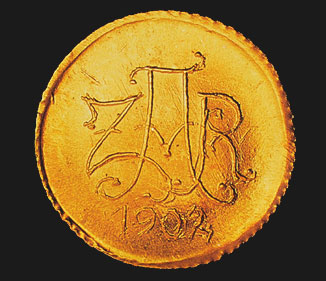
| Year: | 1902 |
|---|---|
| Coin: | Veld Pond |
| Diameter: | 22,8mm |
| Mass: | Approximately 8 grammes |
| Edge: | Milled |
| Designer: | P.J. Kloppers |
| Metal Content: | Virtually 24 carat gold |
| Mintage Figure: | 986 |
| Design: | ZAR in decorative script |
|---|---|
| Inscription: | ZAR 1902 |
| Remarks: | This is South Africa’s most unusual coin. The ‘Veld Pond’, as it is known, was struck at a gold mine workshop in Pilgrims Rest from hand made dies using a heavy fly press. There have been many known forgeries. These coins are also known as Siege pieces, or Money of Necessity. |
| Design: | Een Pond, in decorative lettering |
|---|---|
| Inscription: | EEN POND |
| Remarks: | N/A |
During the Anglo-Boer war there was a shortage of coins for provisions for the Boer troops. Consequently, a Mint was established in the field/veld at Pilgrims Rest. A 29 year old former school teacher, Mr PJ Kloppers, was appointed as the Head of the Mint. A hand press was improvised and discs of 24 carat gold were manufactured. Remarkably, these coins were struck with only one pair of dies and a lathe turned by two men. These coins are classified as ‘Siege Pieces’ or ‘Money of Necessity’. Forgeries were made as early as 1903 as it was a lucrative business after the Anglo-Boer war when high prices (£8 – £10) were paid by the public for them.
The 1898 Single “9” is the most important African coin. Sold by Rare Coin Investments.
Don't get caught out!
A guide to the states of condition that can cause a coin to be rejected for NGC certification.